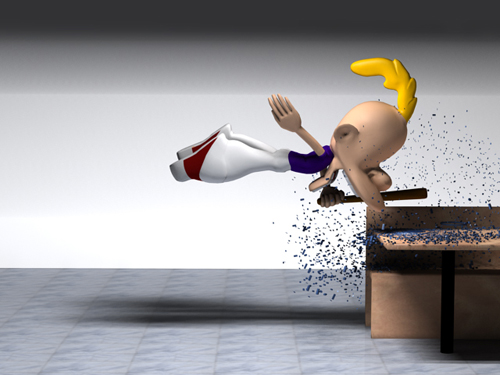
Creating a cartoon certainly isn’t easy. For me, the hardest part was skinning the model. I don’t dare to admit how many hours I’ve spent on this, but it’s an interesting challenge.
Here’s the video in AVI format or in MOV (Quicktime) format
Creating a cartoon certainly isn’t easy. For me, the hardest part was skinning the model. I don’t dare to admit how many hours I’ve spent on this, but it’s an interesting challenge.
Here’s the video in AVI format or in MOV (Quicktime) format
Stumbled upon Calabi Yau manifolds quite by chance, they attempt to represent 10-dimensional space in string theory. I don’t understand a word of the article but they struck me as rather pretty geometry:
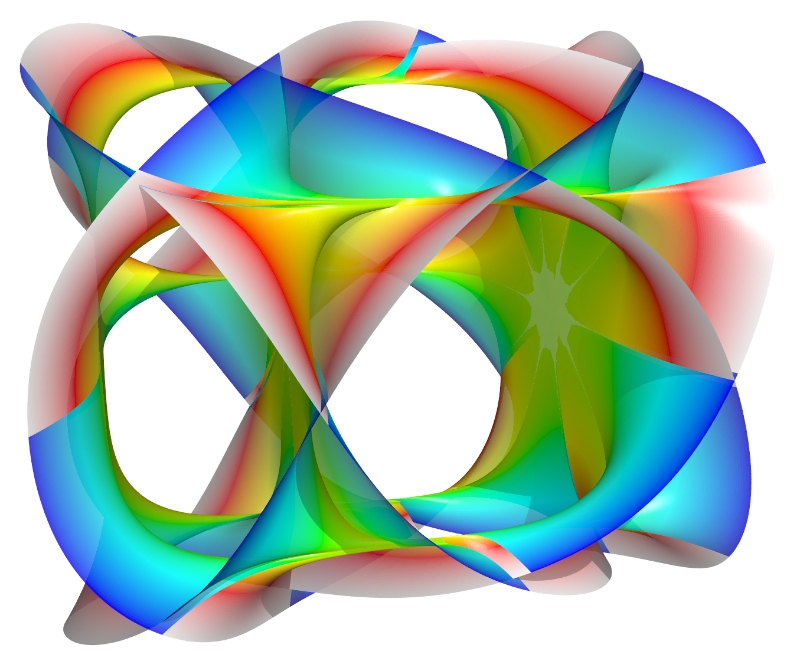
Here are some high-resolution images that I made with the excellent POVRay renderer.
Enjoy.
Set myself the task of learning how to make a cartoon. Lacking artistic skills, I decided to use a local character, Zep‘s Titeuf as a model. I bought a figurine at the local toy shop and used photos of it to build the mesh. Skinning the legs was the hardest part, they’re so short and fat that the creasing has to be adjusted a pixel at a time.
The first results are encouraging:
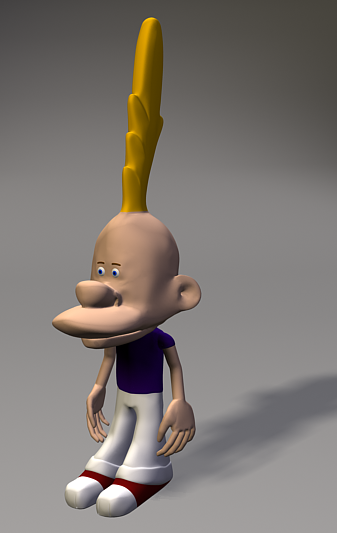
Video:
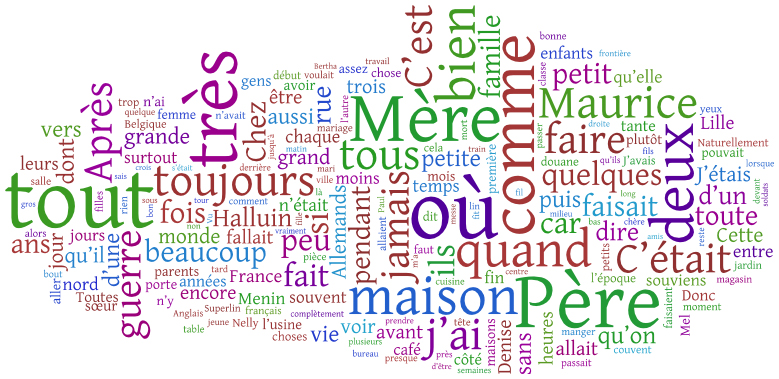
I fell quite by accident on http://www.wordle.net, a program to layout words written by Jonathan Feinberg at IBM. The results it produces are breath-takingly beautiful, I’m at a loss for words (pun intended).
I dropped my mother’s autobiography (56’000 words) into Wordl:
The major words of the text spring out immediately, quite astonishing.
These past few months I’ve been doing a lot of research and with time I was getting more and more annoyed by subscription-only sites (experts-exchange) and catalogs of abstracts (citeseer), they provide me with nothing and clutter up my Google results.
To solve this problem I used Add-in Express for Internet Explorer to build an add-in for Internet Explorer, which would allow me to hide irrelevant sites. Just for the fun, I extended it to handle all the major search engines, trickier than I initially expected but all good clean fun.
In the spirit of the Internet, I’ve published it, you can pick up a copy here.
P.S. The products and the service at add-in-express.com are amongst the best I’ve seen in a long time, highly recommended.
Many traffic-light solutions for Excel exist but all the ones I tried only work for a single light, and I needed an array like this:
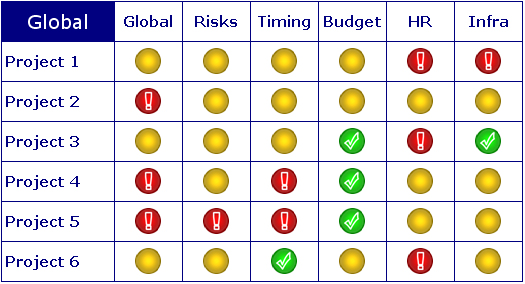
I wanted to create a light by simply typing a formula in the light’s cell, with the colour of the light determined by a value in cell elsewhere. The light must change colour as soon as the underlying value changes. This wasn’t as simple to implement as I thought, but in the end a bit of VBA led to this formula :
=trafficlight(Sheet2!B4,Sheet2!B$3,Sheet2!C$3)
and the rest of the lights are created by dragging this formula right and down.
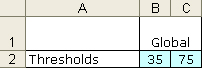
The parameters to the TrafficLight function are:
in this example, the Sheet2 looks like this:
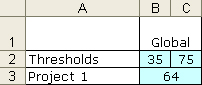
Project 1 has a value of 64 and thus is amber.
Here’s a ZIP file with the .XLS and the images project-progress-dashboard, feel free to use it as you see fit.
Notes:
A good portion of our lives is spent trying to make things work, be they a microwave oven, a coffee machine or, God help me, a television.
Our first television was in 1962, with two channels, BBC and ITV. It was black and white with a resolution of 405 lines. (BBC2 introduced 625 lines in 1964). There were 4 controls: on/off/channel, volume, brightness and contrast. Here we are, 45 years later, with fundamentally the same primitive technology, and the most ghastly user interface and technology produced by man.
The TV industry has been plagued by a plethora of so-called standards: the American NTSC, the British PAL, the French SECAM, and a host of variants, all mutually incompatible. The result is that viewers who want to watch programs from neighbouring countries have to buy much more expensive dual-standard televisions. Concomittantly, enormous sums have been spent trans-coding programs between standards, with consumers footing the bill.
The video industry fares no better. No sooner were video casettes invented, manufacturers developed mutually-incompatible formats (VHS, BETAMAX, VIDEO 2000), again forcing consumers to buy dual-standard players. Learning nothing from past mistakes, the DVD industry also started a standards war (which was finally settled by Lou Gerstner). But true to form, they quickly created two dual-layer recoding standards, DV- and DV+, so that the public could be confused and once again milked. An identical standards war is now in progress for the next generation, between Sony/Panasonic’s Blu-ray Disc, Toshiba’s HD DVD and Maxell’s Holographic Versatile Disc.
Let’s take a look at some parallel technologies. Not one has made such a pigs ear of it as television:
Compact Disks (CDs) were coined barley 20 years ago. The technology was well thought-out, cheap and perfectly standardised; the proof of good design is that it hasn’t had to change since its inception.
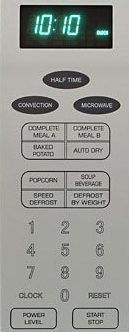
Kitchen appliances have evolved immensely. Microwave ovens, also born in the late 70’s, have revolutionised cooking and their manufacturers have delivered carefully crafted interfaces, comprehensible even by those whose IQ doesn’t exceed their shoe-size:
The telephone (fixed, cordless and mobile GSM) is a further technology whose engineers have produced miracles. My mobile phone not only allows me to talk to anyone on the planet instantly, but also has a camera (still and video), remindes me of my appointments and displays my emails. The palm-sized package communicates over GSM, USB and Wifi (802.11b/g), has a display quality that rivals current television and costs less than half the price of a television receiver.
Television technology is pathetic and it’s getting worse. Here is the ghastly botch-up that I am compelled to use if I want to watch TV:
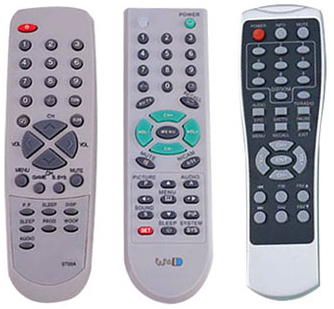
125 buttons just to watch a TV program?
It patently hasn’t occurred to the half-wits who designed this rubbish that my real needs are:
None of the 125 buttons point me intuitively to meet those needs. What the hell are all those random colours and unrecognisable icons for? Why must I have three different controls? (Yes, I know that some remotes can double for their buddies, but I’ve yet to meet someone who can manage the feat). I can’t remember that BBC1 is channel 491, why the hell can’t I have an alphanumeric keyboard? A PC keyboard has less buttons.
The worst interface created by man.
P.S. We have a television, but I never watch it.