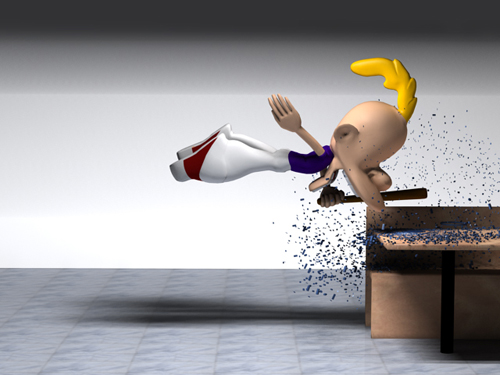
Creating a cartoon certainly isn’t easy. For me, the hardest part was skinning the model. I don’t dare to admit how many hours I’ve spent on this, but it’s an interesting challenge.
Here’s the video in AVI format or in MOV (Quicktime) format
Creating a cartoon certainly isn’t easy. For me, the hardest part was skinning the model. I don’t dare to admit how many hours I’ve spent on this, but it’s an interesting challenge.
Here’s the video in AVI format or in MOV (Quicktime) format
Stumbled upon Calabi Yau manifolds quite by chance, they attempt to represent 10-dimensional space in string theory. I don’t understand a word of the article but they struck me as rather pretty geometry:
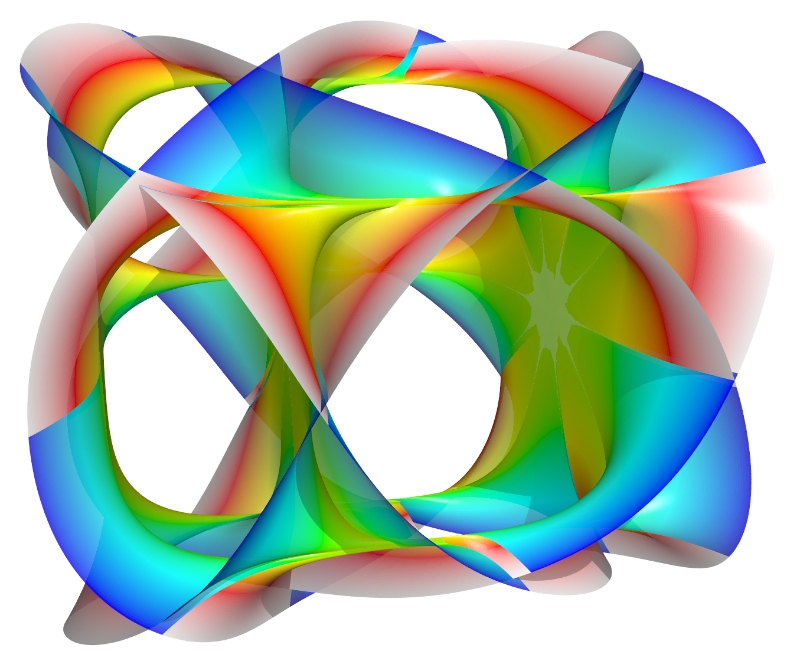
Here are some high-resolution images that I made with the excellent POVRay renderer.
Enjoy.
Set myself the task of learning how to make a cartoon. Lacking artistic skills, I decided to use a local character, Zep‘s Titeuf as a model. I bought a figurine at the local toy shop and used photos of it to build the mesh. Skinning the legs was the hardest part, they’re so short and fat that the creasing has to be adjusted a pixel at a time.
The first results are encouraging:

Video:
Debate about figures of speech in the family at dinner this evening, with the customary arguments about the differences between English and French varieties.
As usual (universally?) Wikipedia is a treasure trove, and I loved this example of paronomasia:
Atheism is a non-prophet institution
it quite made my evening.
The media are lathering us all up to the prespective of a great depression, matched only by 1929. Obama is just hanging in on page 4, and only because some deranged young idiot was supposedly plotting to assassinate him. As for McCain and Palin, they’ve completely dissapeared from the news radar, at least here in Switzerland.
I never cease to be amazed at how short peoples’ memory is. The stock market has gone through innumerable crises, the 1973-1974 wiped 45% off the DOW, black Monday (1987) took 22.6% off the DOW and the .COM bubble in 2000 cost speculators (and others) about $5 trillion. The world’s banks employees, motivated by bonuses that bear no relation to their true added value have been playing the market for years and now we are at the day of reckoning. And so what? We’ve lived through them before, we’ll live through this one again, and in 3 years the autumn-2008 meltdown will be no more than a page on Wikipedia, like the others.
But. And there is a “but” this time round. The previous disasters were accompanied by liberal doses of “well, take your medecine”. This time it’s very different. Governments suddenly made billions available to ailing banks and in the same breath announced that money for all other causes was short. Here in Switzerland, where UBS was bailed to the tune of 68’000’000’000 CHF (about the same number of dollars), the minimum interest rate on pension funds was slashed simultaneously.
Let us take a step back. In 1974 (and 1987, and 2000), we were fed the same crap. In 2006-2007, everyone was back to worshipping the incredible economy.
Will we never learn?
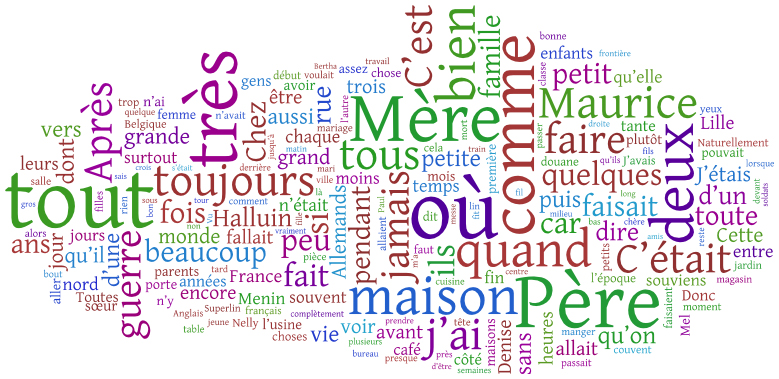
I fell quite by accident on http://www.wordle.net, a program to layout words written by Jonathan Feinberg at IBM. The results it produces are breath-takingly beautiful, I’m at a loss for words (pun intended).
I dropped my mother’s autobiography (56’000 words) into Wordl:
The major words of the text spring out immediately, quite astonishing.
These past few months I’ve been doing a lot of research and with time I was getting more and more annoyed by subscription-only sites (experts-exchange) and catalogs of abstracts (citeseer), they provide me with nothing and clutter up my Google results.
To solve this problem I used Add-in Express for Internet Explorer to build an add-in for Internet Explorer, which would allow me to hide irrelevant sites. Just for the fun, I extended it to handle all the major search engines, trickier than I initially expected but all good clean fun.
In the spirit of the Internet, I’ve published it, you can pick up a copy here.
P.S. The products and the service at add-in-express.com are amongst the best I’ve seen in a long time, highly recommended.
Many traffic-light solutions for Excel exist but all the ones I tried only work for a single light, and I needed an array like this:
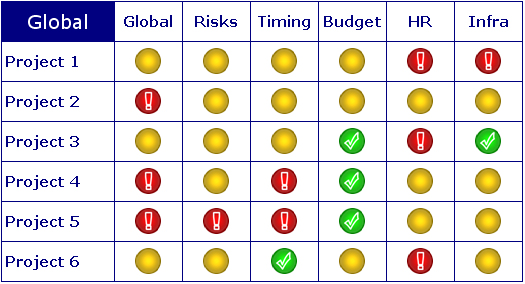
I wanted to create a light by simply typing a formula in the light’s cell, with the colour of the light determined by a value in cell elsewhere. The light must change colour as soon as the underlying value changes. This wasn’t as simple to implement as I thought, but in the end a bit of VBA led to this formula :
=trafficlight(Sheet2!B4,Sheet2!B$3,Sheet2!C$3)
and the rest of the lights are created by dragging this formula right and down.
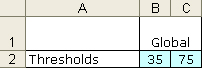
The parameters to the TrafficLight function are:
in this example, the Sheet2 looks like this:
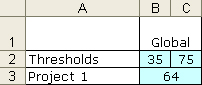
Project 1 has a value of 64 and thus is amber.
Here’s a ZIP file with the .XLS and the images project-progress-dashboard, feel free to use it as you see fit.
Notes:
Quite astonishing that for once the European politicians have got their act together and addressed the financial cesspool that the banks have created. A shining performance by Sarkozy and Brown, from whom nobody expected such alacrity and cooperation.
On the other side of the pond (is Bush still president over there?), McCain is too busy slinging mud at Obama in a last-ditch effort and Paulson’s plan seems rather ineffectual by comparison to the Europeans’.
It seems that Europe is finally assuming the role it should take; with a population of some 450 million it’s about time.
I was flabbergasted to learn that the price of car insurance in Switzerland is a function of your nationality. The surcharge can be as high as 97% if your unlucky enough to be from pretty well anywhere in the sourth-eastern Medditerranean area and, curiously, anywhere in north or south America (article in French).
The insurers argument is that drivers from certain countries statistically have more accidents. Now I can follow the reasoning, the problem is that each company has wildly differing prices for a given nationality, which to me smells of poor statistics. If the sample is large, the surcharges should be approximately the same.
What’s even worse is that the no-claims bonus is aplied on the surcharged price. This means that a driver from country X, whose initial policy has a 94% surcharge, who has no accidents for 10 years is penalised forever.
Legal as it may be, this practice stinks of racism. Shame on the Swiss; are they alone in doing this?